Be yourself; Everyone else is already taken.
— Oscar Wilde.
This is the first post on my new blog. I’m just getting this new blog going, so stay tuned for more. Subscribe below to get notified when I post new updates.
Be yourself; Everyone else is already taken.
— Oscar Wilde.
This is the first post on my new blog. I’m just getting this new blog going, so stay tuned for more. Subscribe below to get notified when I post new updates.
Article: https://www.benefitscanada.com/news/a-refresher-on-canadas-leave-policies-as-coronavirus-escalates-143548 *PUBLISHED MARCH 13 2020. CHANGES TO POLICY MAY HAVE BEEN MADE SINCE
With COVID-19 increasing at a rapid pace, there has to be a look at the workplace-leave policies for employees in order to maintain optimal public health. Policies need to be adjusted and governments need to reconsider paid leave positions. Justin Trudeau and government are waiving the waiting period for benefits for those who are off of work due to illness. Although the Democratic Party Leader Jagmeet Singh said more than half of Canadian workers wouldn’t be helped by that. This is a very important issue as it can have the potential to affect the lives of millions of Canadians and their families. It is not enough for the government to ask individuals to just stay home if they’re worried they are infected by COVID-19. If staying at home means not receiving an income, many may make the choice to work even if they are experiencing symptoms, thus potentially increasing the spread of this coronavirus. Canada must do better to provide their workers with an option to maintain their health while still receiving financial care, which will lessen the impact of COVID-19.
In the United States, Walmart Inc. introduced an emergency leave policy, meaning hourly staff will receive up to two weeks of pay if quarantined or if diagnosed with COVID-19. If they are unable to return to work additional pay may be provided for 26 weeks. Walmart’s senior vice-president claims “we are looking to provide some additional support so employees can better weather these times”. This would be extremely beneficial to many workers, lifting a weight off their chest and could be a potential option for some companies in Canada.
In Canada, there have been many different bills and standards set out in different provinces related to sick-leave. In 2017, Ontario expanded personal emergency leave to 10 days per year with two days paid. In Alberta in 2018, the province standard was five days of unpaid leave for personal emergencies, and 16 weeks of unpaid leave for long-term illness or injury.
During the H1N1 Outbreak in 2009, Nova Scotia amended its labour standards code to create an unpaid emergency leave in response to concerns about the pandemic.
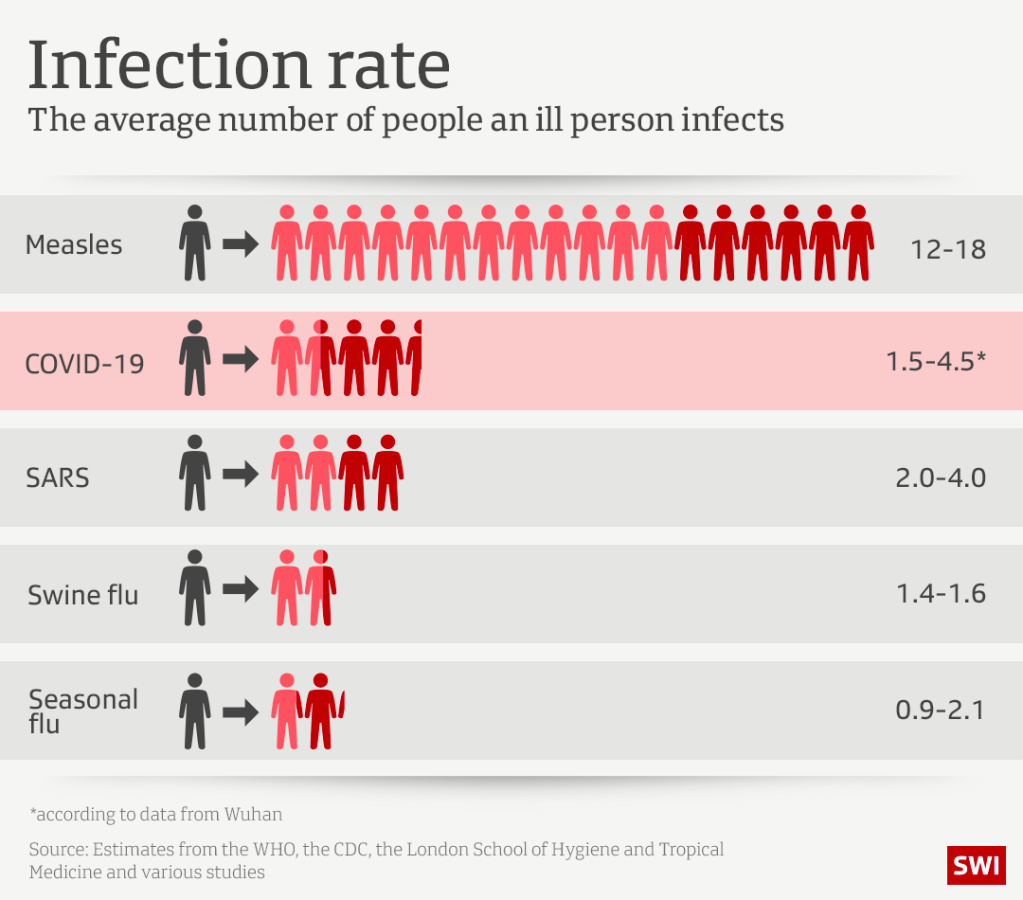
This graphic displays how COVID-19 is more infectious than H1N1, meaning a policy is needed to be put in place for workplace leave alike what Nova Scotia did for the Swine Flu in 2009, but more drastic.
COVID-19 highlights the need for these types of provisions. It has been suggested that the government should give 14 paid sick days every year. The suggestion of 14 days is because a typical COVID-19 related quarantine lasts for a 14-day period [2]. This pandemic was an unexpected, progressive outbreak, which means the government is trying to fix issues like this as quick as they can. The policies and legislations will continute to change as this virus spreads, meaning there is no one right answer on how to fix workplace-leave policies as this is an extreme emergency situation. Canada must consider their citizen’s health, while keeping into consideration that their financial status may be on the top of their priorities, and not their indvidual health. Financial aid needs to be provided in order for those positive with COVID-19 to self-isolate and recover to lessen the impact of this viral outbreak.
References
[1] Benefits Canada. (2020, March 13). A refresher on Canada’s leave policies as coronavirus escalates. Retrieved from https://www.benefitscanada.com/news/a-refresher-on-canadas-leave-policies-as-coronavirus-escalates-143548
[2] Cornell Health. (2020, March). Quarantine for COVID-19. Retrieved from https://health.cornell.edu/resources/health-topics/quarantine-covid-19
[3] Stephens, T. (2020, February 26). Coronavirus: Head-shaking doctors and non-hand-shaking workers. Retrieved from https://www.swissinfo.ch/eng/covid-19_coronavirus–head-shaking-doctors-and-non-hand-shaking-workers/45580772
Article: https://www.cbc.ca/news/canada/prince-edward-island/pei-paid-leave-domestic-violence-1.5325699
Prince Edward Island is about to undergo changes as a result of a development of the Employment Standards Act. As of November 1st, victims of domestic abuse are entitled to a paid leave from their place of work. This paid leave can be taken all at once or intermittently, an can take up to three days paid and three days unpaid. Other provinces already have this legislation in place. In Ontario, employees who have been employed for 13 consecutive weeks are entitled to a domestic or sexual violence leave if the employee or their child has been threatened under certain circumstances (Ontario, 2019). Ontario employees can take five days of paid leave, with the rest unpaid. Their leave can be used up to 15 weeks of the calendar year (Ontario, 2019). In P.E.I., employees had to be on the job for at least three months, and have experienced at least one of the following circumstances: needed to move residence quickly due to emergency, or if they needed to seek medical or legal services. The workplace leave in P.E.I. can be entitled to the victim or their close family members.
The most difficult issue regarding this change in the Employment Standards Act is disclosing that violence has occurred. Despite prior efforts to increase awareness about domestic violence, it remains unrecognized and underreported (Davis et al., 2003). According to Burn (2015), victims of domestic violence already feel badly about themselves and their situation, which is a reason why they do not open up for help. If an employee is currently experience domestic violence, or has experienced domestic violence, it can be very difficult for them to open up to anyone, let alone their employer looking to take time off work.
Domestic violence is defined as “violent or aggressive behaviour within the home, typically involving the violent abuse of a spouse or a partner”. There are many occurrences of violence outside of the home that can lead to extreme trauma, which can be another issue regarding this legislation. Why aren’t victims of violence in general entitled to paid time off work? Why is the line drawn at abuse from close relationship or family members? As shown in the chart below, there are many forms of violence, and sometimes are not visible. This types of violence occurs from individuals other than domestic relationships, yet there is no current legislation for those victims.

References
Burn, S. M. (2015, October 17). How to Help Someone in an Abusive Relationship. Retrieved from https://www.psychologytoday.com/ca/blog/presence-mind/201510/how-help-someone-in-abusive-relationship
Davis, J. W., Parks, S. N., Kaups, K. L., Bennink, L. D., & Bilello, J. F. (2003). Victims of Domestic Violence on the Trauma Service: Unrecognized and Underreported. The Journal of Trauma: Injury, Infection, and Critical Care, 54(2), 352–355. doi: 10.1097/01.ta.0000042021.47579.b6
Medibank. (2018, May 24). How to support someone experiencing domestic violence. Retrieved from https://www.medibank.com.au/livebetter/my-medibank/healthcare/support-a-friend-domestic-violence/
Ontario. (2019, October 21). Domestic or sexual violence leave. Retrieved from https://www.ontario.ca/document/your-guide-employment-standards-act-0/domestic-or-sexual-violence-leave
Oxford English Dictionary. (n.d.). Domestic, adj. and n. Retrieved from https://www.oed.com/view/Entry/56663?redirectedFrom=domestic+violence#eid41827739
My name is Maddie Love. I am a third year health studies student here at Queen’s University.
My first job that was important to me (and is still my current job) is being the Queen’s University Volleyball Suprevisor through Queen’s Athletics and Recreation (Home Events). This is a memorable job because it has shaped my future career aspirations, as I wish to continue to work in the sports industry on the business/management side.
I am interested in learning about ways employers/employees go about solving problems, as I am constantly faced with barriers I need to overcome at my job.
This is an example post, originally published as part of Blogging University. Enroll in one of our ten programs, and start your blog right.
You’re going to publish a post today. Don’t worry about how your blog looks. Don’t worry if you haven’t given it a name yet, or you’re feeling overwhelmed. Just click the “New Post” button, and tell us why you’re here.
Why do this?
The post can be short or long, a personal intro to your life or a bloggy mission statement, a manifesto for the future or a simple outline of your the types of things you hope to publish.
To help you get started, here are a few questions:
You’re not locked into any of this; one of the wonderful things about blogs is how they constantly evolve as we learn, grow, and interact with one another — but it’s good to know where and why you started, and articulating your goals may just give you a few other post ideas.
Can’t think how to get started? Just write the first thing that pops into your head. Anne Lamott, author of a book on writing we love, says that you need to give yourself permission to write a “crappy first draft”. Anne makes a great point — just start writing, and worry about editing it later.
When you’re ready to publish, give your post three to five tags that describe your blog’s focus — writing, photography, fiction, parenting, food, cars, movies, sports, whatever. These tags will help others who care about your topics find you in the Reader. Make sure one of the tags is “zerotohero,” so other new bloggers can find you, too.

 Maddie's Blog